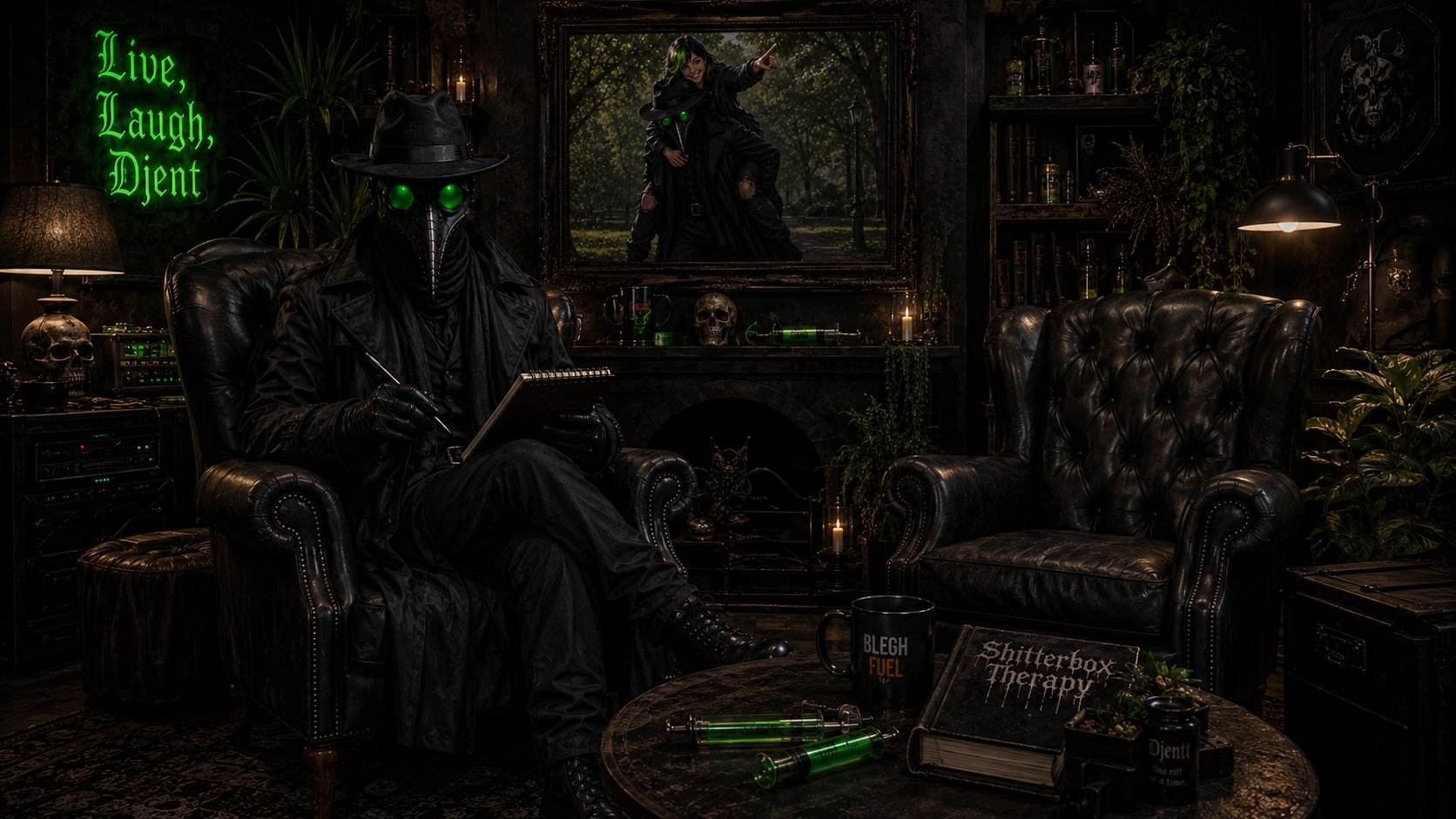
Ahem. Welcome, patients, creators, lurkers, and those who clicked this page by mistake and are now legally part of the experiment.
Today, I sit down with Fractal, a fellow Djentleman, the proprietor of The Lyric Lab, and a former drummer whose relationship with the metronome can only be described as "complicated."
Do not worry. I have prepared tea. I have also prepared ear protection, structural bracing, and a waiver. We will see which becomes necessary first.
I would describe it as emotionally unstable architecture made of drumming and riffs.
Fractal is where heavy metal, djent, atmosphere, groove, and questionable rhythmic decisions all get locked in a room until something starts glowing. I like music that feels massive, but not mindless. Heavy, but not just “angry refrigerator falling down stairs” heavy. I want the riffs to hit hard, the atmosphere to feel alive, and the whole thing to sound like it was assembled by a man staring directly into a spiral while muttering, “No, no… the breakdown needs more gravity.”
So, basically: cosmic groove violence with emotional damage and good manners.
“Cosmic groove violence with emotional damage and good manners.” I am writing that directly onto your chart. Most patients cannot describe their own condition this accurately. You may be the first to arrive pre-diagnosed.
Yes.
The name came from the idea of something endlessly complex collapsing into one impossible point. A fractal is pattern inside pattern, detail inside detail, chaos that secretly has structure. A singularity is where the rules stop pretending they’re in charge.
That felt right for what I do creatively. I love music that has layers, strange turns, odd rhythms, and emotional weight, but still pulls everything toward one central impact.
Also, “Fractal Singularity” sounds like a guy who got banned from three rehearsal spaces for tuning too low near active electronics, and I respect that. Well that and my original name on Suno was “WanderingFutureFunk691”, so Fractal sounds better.
An excellent clinical decision. “WanderingFutureFunk691” is not a name, it is a symptom. “Fractal Singularity” at least sounds like it could sign a hospital form.
Heavy Metal gives emotion a suit of armor. Djent gives that armor a math degree and a bad attitude (I have no math degree).
What keeps pulling me back is the physicality of it. The groove. The tension. The way a good riff can say more than a paragraph if it lands right. Heavy music has this incredible ability to express frustration, grief, defiance, triumph, dread, absurdity, and beauty without needing to soften itself. Randy Blythe, the frontman for the band Lamb of God, once said of Heavy Metal that “We do all the screaming and yelling so that you don’t have to”. I can’t think of a better way to describe heavy and aggressive music than what Mr. Blythe said.
And djent specifically scratches the drummer part of my brain. It lets rhythm become the weapon, the hook, the atmosphere, and occasionally the reason the listener forgets how to count to four.
Which, medically speaking, is progress.
“Emotion in a suit of armor.” Yes. Heavy music is simply catharsis that lifts weights. I find the therapy is going remarkably well and no one has had to talk about their feelings out loud even once.
A dangerous amount.
Even when I’m thinking about guitars, I’m usually thinking like a drummer. I hear the kick pattern, the pocket, the accents, the little spaces where the groove breathes before it punches you in the sternum. I’m always chasing that moment where the rhythm locks in and suddenly the riff feels ten times heavier without needing to be faster or louder.
Being a former drummer means I’m incapable of leaving a perfectly normal 4/4 pattern alone. I see a simple groove and immediately think, “Beautiful. What if we made this emotionally inconvenient?”
So yes, the rhythmic damage is real. I apologize to the metronome. We have history.
The metronome has filed no complaint, which I find more concerning than if it had. “Emotionally inconvenient” time signatures are, I am told, the leading cause of listeners nodding their heads before their brains have consented.
Usually it starts with atmosphere or concept, then the rhythm shows up wearing steel-toed boots.
Sometimes I’ll have a lyrical idea first, some dark little thought that refuses to leave. Sometimes it’s a mood: cosmic, swampy, triumphant, miserable, ancient, furious, or “what if the universe had a bass drop?” From there, I start imagining what kind of rhythm belongs to that world.
But yes, sometimes one disgusting breakdown does crawl out of the vents and demand legal ownership of the entire song.
When that happens, you don’t argue. You give it a name, feed it palm mutes, and hope it doesn’t reproduce.
For the record, I do not legally recognize a breakdown’s claim of ownership over a song. However, I have seen what they do when denied, and I will not be intervening.
Very carefully, and with several nurses standing by.
For me, brutality only works if there’s contrast. If everything is heavy all the time, nothing feels heavy anymore. You need space, groove, melody, atmosphere, tension, release, and moments where the listener can breathe just long enough to realize the next riff is already standing behind them.
I try to make sure every element has a job. The brutality brings impact. The groove brings movement. The melody brings memory. The emotion gives the song a reason to exist beyond “look how many strings we have angered.”
The trick is not letting the monster become a pile of parts. It still has to walk. Preferably toward the listener. Slowly. In 13/8.
A sound surgical philosophy. Contrast is what keeps the patient alive on the table. Anyone can make something loud; making something loud that still breathes is the part they do not teach in medical school, or in music school, apparently.
The spine evacuation is important, obviously.
But for me, a truly satisfying riff is all about rhythm and intention. Tone matters, absolutely. A bad tone can make a great riff sound like a lawn chair falling into a printer. But rhythm is where the real magic happens.
I love when a riff has weight, space, and personality. The silence between the hits is just as important as the hits themselves. That little pause before the next note? That’s where the riff looks you in the eye and signs the waiver.
A great riff doesn’t just hit hard. It moves correctly. It makes your head nod before your brain has finished filing the paperwork.
Djentleman to Djentleman: the silence between the hits is the most underrated organ in the entire body of a riff. Remove it and the whole thing flatlines. You clearly know where the pulse lives.
A little of both.
I usually start with a theme, because I like lyrics to have a spine. I want them to be about something, even if that something is buried under metaphor, smoke, distortion, and poor lighting. The words need to feel intentional. I don’t like throwing in darkness just because darkness looks cool on the furniture.
But once the music starts taking shape, it absolutely affects the language. Some songs want direct words. Some want poetry. Some want something cinematic. Some want to grab you by the collar and whisper something deeply concerning in your ear.
So I build the house with a theme, then let the music decide which rooms are haunted.
“I build the house with a theme, then let the music decide which rooms are haunted.” I will be stealing that sentence and displaying it in my waiting room, uncredited, as is tradition.
It has absolutely opened new doors.
And then I filled those rooms with distortion.
Suno has let me experiment in ways that would have been difficult, expensive, or flat-out ridiculous in a traditional setup. I can blend djent with orchestral elements, phonk, swamp blues, country, black metal, R&B, doom, or whatever other genre combination crawls out of my brain at 2:00 in the morning asking for a passport.
It has also made me think more like a director because I’m not just asking for a sound; I’m building a scene, a mood, a structure, a performance due to the prompting that you have to do. It’s less “make song go chug” and more “please construct an emotionally damaged scene with blast beats and tasteful ambience.”
So yes, Suno has given me more doors. I have responded responsibly by kicking most of them off their hinges.
The doors are, medically speaking, a lost cause. But I am pleased the experimentation is spreading. A creator who blends doom with swamp blues at 2:00 in the morning is exactly the sort of contagious I like to encourage.
Honestly? The Lyric Lab means a LOT to me.
It’s a place where people can bring ideas, lyrics, experiments, weird genre fusions, serious songs, ridiculous songs, and everything in between without feeling like they have to be perfect before they participate. That matters to me. Creativity is already vulnerable enough without someone standing in the corner acting like the riff police.
Being around other creators keeps me inspired. It reminds me that everyone has a different way into the song. Some people start with emotion. Some start with story. Some start with a title. Some start with “what if this sitar had unresolved trauma?”
And honestly, watching people grow creatively is one of the best parts. The Lab isn’t just about lyrics. It’s about momentum, encouragement, and helping people realize that their weird idea might actually be the best thing they’ve made all week.
Also, naturally, we follow strict laboratory safety protocols: goggles on, egos off, and no one touches the forbidden breakdown without supervision. I started it nine months ago and it was my very first foray into Discord and Discord servers, so I had no inkling of what was on the horizon. What grew from just me and just a handful of fellow Suno creators has been a wild ride and I have loved it and I look forward to it each and every day.
And I do want to give a shout out to those handful of Suno creators who actually were there with me at the founding of The Lyric Lab: BlueEyedGuy, Urban Viking, Xak Stahl, Don Nyx, Jimmydsausage, and Zer0blivion (also known as Mement0blivion in some circles). These guys helped me immeasurably in the beginning and it was invaluable.
“Goggles on, egos off” is a healthier operating principle than most actual laboratories manage. A community that lets people be imperfect out loud is doing more medicine than it realizes. My compliments to the founding staff of the Lab.
Initial symptoms may include involuntary head nodding, sudden interest in polyrhythms, excessive use of the word “filthy,” and the belief that most songs could be improved by adding one more catastrophic breakdown.
Advanced cases may involve staring into glowing spirals, describing riffs as architecture, hearing kick patterns in household appliances, and saying things like, “This needs to feel more cosmic, but also like a bulldozer learned grief.”
There is no known cure.
Treatment includes hydration, responsible volume levels, community support through The Lyric Lab, and repeated exposure to medically unnecessary palm muting.
Side effects may include groove, existential reflection, and becoming a certified Djentleman.
A grim diagnosis, but not without hope. The condition is chronic, socially contagious, and worsens noticeably when exposed to low tunings, community feedback, and any appliance with a rhythmic hum. Treatment is lifelong. The patient appears delighted.
Thank you, Fractal, for submitting yourself to the examination. You survived with most of your dignity intact and only a moderate amount of structural settling, which is more than I can say for several of my previous patients.
To everyone reading: listen to his work, let a breakdown or two rearrange your posture, and remember that art is healthiest when it is heavy, deliberate, and just slightly infected.